Cetalog: worth it for a fast agency launch, not long-term flexibility
- SEO and digital marketing agencies
- Elementor users who want prebuilt layouts
- Small business brochure sites
- Freelancers delivering fast client sites
- You prefer the WordPress block editor
- You need WooCommerce-first features
- You want minimal plugin dependencies
- You need a mature, widely adopted theme
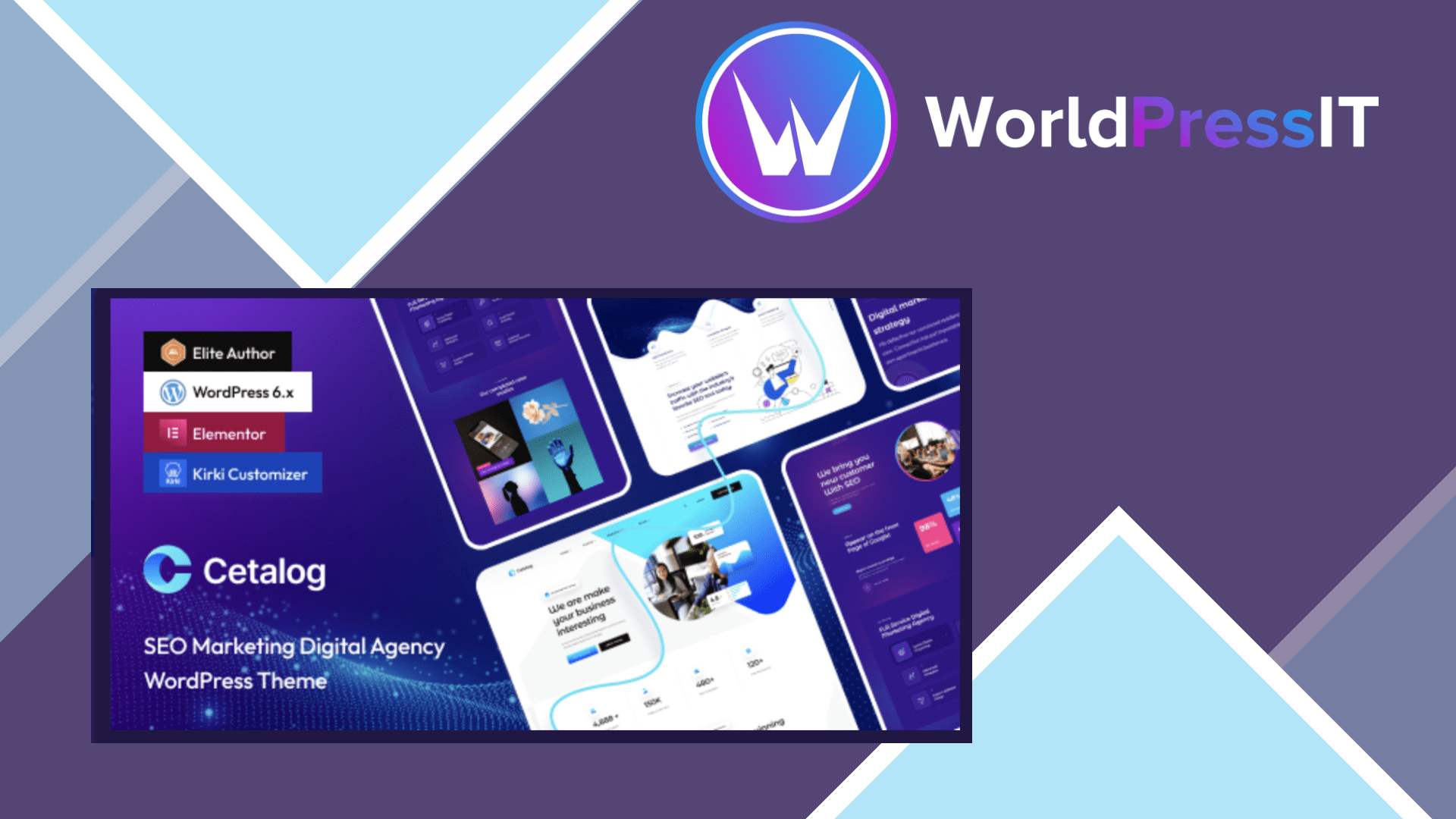
Verdict: Cetalog is a competent niche theme for an SEO, marketing, consulting, or creative agency that wants to launch from a finished visual direction rather than design every page from scratch. It includes three homepage demos, more than 20 inner pages, three header variations, two footer variations, RTL support, WPML compatibility, and more than 35 custom Elementor widgets. That is a useful package when the demo already resembles the site you need.
Its strongest point is speed of assembly. Elementor provides the editing workflow most small agencies and freelancers already understand, while the included custom widgets cover familiar agency content such as services, case studies, testimonials, calls to action, and team sections. The theme is responsive, based on Bootstrap 5, includes a child theme, and exposes color, typography, header, footer, breadcrumb, blog, and post-type settings through the Customizer. The documentation is unusually concrete about installation, demo import, updates, and server requirements.
There is also evidence that the developer still maintains it. The marketplace changelog records updates through August 2026, including compatibility work for WordPress and bundled plugins. The listed regular license is $79 and includes future updates, although support is limited to six months unless extended. Those facts make Cetalog less risky than an abandoned theme with no recent maintenance history.
The weaknesses are more important than the feature list. Cetalog is not Gutenberg optimized, so it is a poor match for a block-editor-first workflow. Its useful functionality depends on Elementor and the developer’s TP Core plugin, along with other required plugins. The documentation recommends a fresh site for installing the required plugins and demo content, which is a warning against dropping it into an established production site without testing. It also specifies a WordPress memory limit of at least 128 MB, with recommended upload and execution settings, so cheap or tightly restricted hosting may create avoidable setup friction.
Past marketplace comments identify concrete problems rather than vague dissatisfaction: one user reported that only two of four footer widgets appeared and that the footer was buggy; other buyers reported broken demo imports, installation trouble, a 404 when opening a support ticket, and slow replies. Some of those issues were later resolved, and recent updates are encouraging, but they show that the one-click setup is not guaranteed to be effortless.
Compared with Hello Elementor, Cetalog gives you far more ready-made agency structure but locks you more tightly into its theme ecosystem. Compared with Astra or Kadence, it is more visually specific and faster to turn into a marketing site, but less flexible as a long-term foundation. Compared with GeneratePress, it is much less focused on lean, modular performance. Buy Cetalog when its demos save real design time; otherwise, choose a more established general-purpose theme and add an agency template kit.
Questions people ask
- Is Cetalog a good WordPress theme for an SEO agency?
- Yes, if you want a ready-made agency presentation and plan to use Elementor. Its layouts and custom widgets are aimed directly at services, case studies, testimonials, and marketing-focused pages.
- Does Cetalog work with Gutenberg?
- It may coexist with WordPress, but the marketplace listing explicitly marks it as not Gutenberg optimized. Choose a block-first theme if the WordPress Site Editor is central to your workflow.
- Does Cetalog require Elementor?
- Its main layouts and more than 35 custom widgets are built around Elementor, so Elementor and the theme's companion functionality should be treated as required for the advertised experience.
- Is Cetalog easy to install?
- The documentation provides one-click and manual demo-import instructions, but it also recommends using a fresh site and lists a 128 MB minimum WordPress memory limit. Earlier buyers reported broken demo imports and installation issues.
- Is Cetalog better than Astra for an agency website?
- Cetalog is faster if its visual demos closely match your agency, while Astra is the safer choice for broader compatibility and future flexibility. Cetalog wins on niche presentation; Astra wins as a general-purpose foundation.
Get Cetalog: worth it for a fast agency launch, not long-term flexibility 1.0.9
Complete package, ready to install, via WorldPressIT.