Miller: attractive niche design, but not worth the security and builder baggage
- personal assistants who need a brochure site
- virtual assistant businesses copying the demo layout
- freelancers comfortable with WPBakery
- developers maintaining legacy ThemeREX sites
- you want native block-editor workflows
- you need a lean, fast-loading theme
- you require dependable long-term security
- you are building a custom booking platform
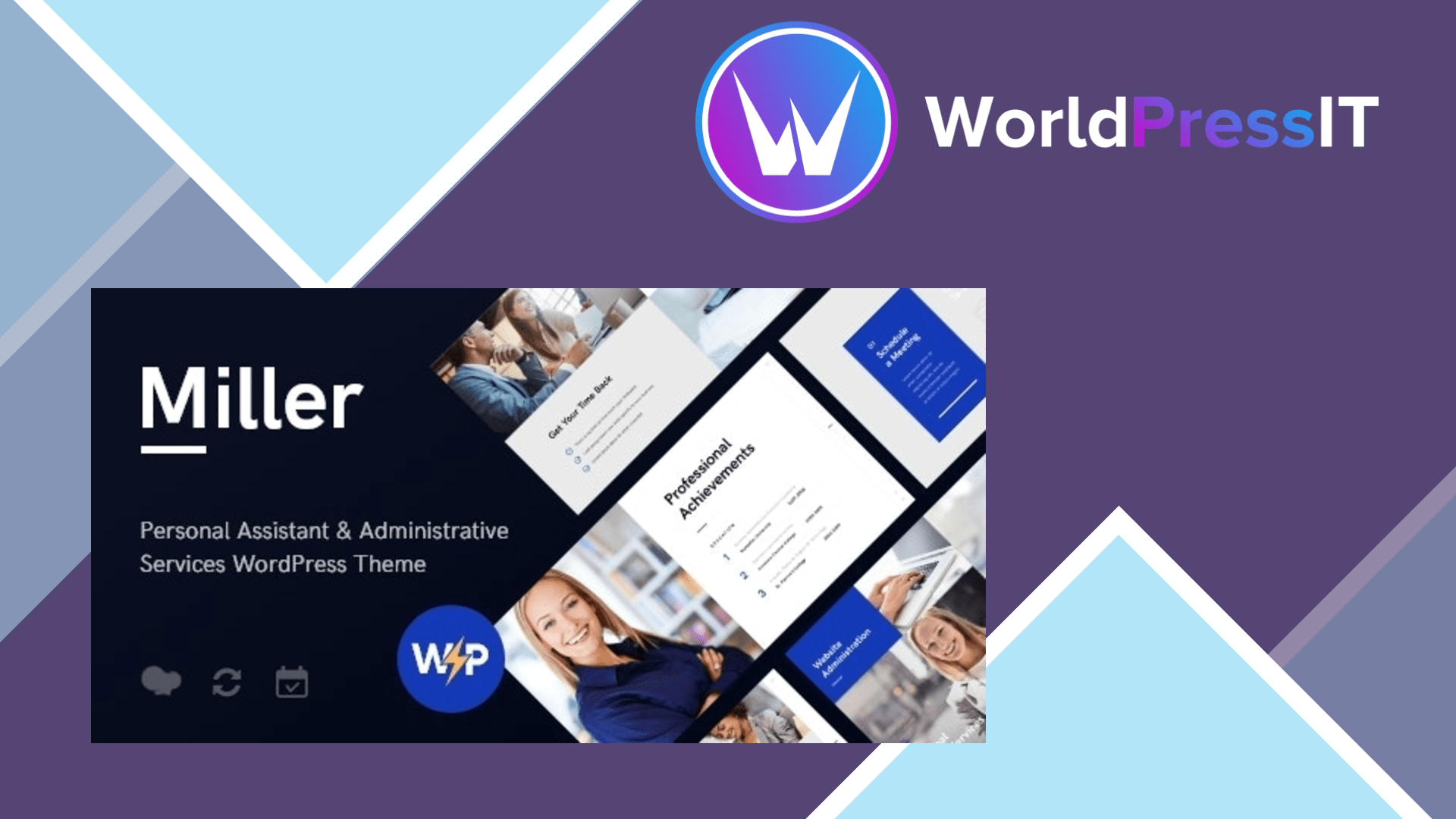
Miller gets the niche positioning right. It is clearly designed for personal assistants, administrative agencies, consultants, concierge services, and virtual assistants rather than being a generic corporate theme with the copy swapped out. The demos provide service-focused sections, portfolio and skills layouts, contact forms, blog templates, appointment-related integrations, and both one-page and multi-page structures. If your goal is a polished brochure site that resembles the preview with minimal design work, Miller can save time.
The strongest part is the visual starting point. The theme offers boxed and full-width layouts, a classic menu and a side-scrolling menu, flexible colors and typography, sliders, custom post types, service-oriented content blocks, and a large ThemeREX options framework. The product page lists more than 750 Customizer options, plus support for Essential Grid, Revolution Slider, MailChimp for WordPress, Contact Form 7, Booked Appointments, and ThemeREX Addons. The listed price is $69 and includes six months of author support, which is reasonable if you are buying the exact design rather than a general-purpose theme.
That convenience comes with a substantial maintenance cost. Miller’s demo content and existing layouts are built with WPBakery Page Builder, and the documentation says those layouts should be customized through WPBakery rather than casually switching editors. The documentation also identifies ThemeREX Addons as mandatory for proper theme functionality, while WPBakery is required for the supplied layouts. This creates a tightly coupled theme-and-plugin stack: removing the builder or theme-specific add-on can leave content difficult to edit or partially broken. Astra, Kadence, and GeneratePress are less visually specific out of the box, but they work more naturally with blocks, modern page builders, and independently replaceable plugins.
There is also contradictory positioning around the editor experience. The marketplace metadata says Miller is not Gutenberg optimized, while the developer’s newer marketing page describes it as Gutenberg ready and even promotes Elementor. The documentation is more revealing: new pages can use Gutenberg, but the prebuilt demo pages remain WPBakery-based. That is compatibility, not a genuinely block-first workflow. Users who expect the Site Editor or a clean Elementor build should choose a theme designed around that ecosystem instead.
The deciding problem is security history. Wordfence lists an unauthenticated local file inclusion vulnerability, CVE-2026-28053, affecting Miller versions up to 1.3.3 and rates it with a CVSS score of 8.1. The marketplace lists version 1.3.4, but its changelog only describes improved WordPress 6.7.2 compatibility and style changes; it does not explicitly document the vulnerability fix. That does not prove the current release is vulnerable, but it is not enough reassurance for a fresh production site. Confirm the patch directly with the developer before considering deployment.
Verdict: Miller is a reasonable legacy-theme replacement or a narrowly defined design purchase for an experienced administrator, but it is a poor default in 2026. Kadence or Astra will give most service businesses a more flexible and maintainable base, while a dedicated booking plugin can handle appointments without tying the entire site to an old theme framework.
Questions people ask
- Is Miller a good WordPress theme for virtual assistants?
- It has one of the more targeted designs for virtual assistants and administrative services, so it can work well for a simple brochure site. However, its WPBakery and ThemeREX dependencies make it harder to maintain than newer alternatives.
- Does Miller work with Gutenberg?
- Gutenberg can be used for new pages, but the supplied demo pages and layouts are built with WPBakery and the documentation recommends editing them with WPBakery. It is compatible with blocks, not truly block-first.
- Does Miller include appointment booking?
- Miller is compatible with Booked Appointments and related calendar integrations, but the theme itself is not a complete booking system. You still need to configure and maintain the supporting plugin.
- Is Miller secure to use?
- Versions through 1.3.3 are listed with an unauthenticated local file inclusion vulnerability, CVE-2026-28053. The marketplace lists 1.3.4, but you should verify directly that this release fixes the issue before installing it on a production site.
- What is a better alternative to Miller?
- Kadence or Astra are better general-purpose choices for a new site because they are less tied to a proprietary theme framework and work well with blocks and modern builders. Pair either with a dedicated booking plugin if appointments are essential.
Get Miller: attractive niche design, but not worth the security and builder baggage 1.1.6
Complete package, ready to install, via WorldPressIT.